AETHUS

Ophthalmology SEO for UK Eye Surgeons and Private Eye Clinics

Aethus is a UK SEO agency for private ophthalmologists and eye surgeons. We run SEO, Google Business Profile and AI-search visibility for cataract, lens replacement and vision-correction practices, and the three private eye practices we work with have grown their Google search clicks 3x, 17x and 18x.

Free audit, no obligation. Fixed monthly fee agreed in writing before any work starts.

Award-winning web designHealthcare websites since 2015Senior-led deliveryBedford, UK
5.0 · 7 Google reviews

Get your free ophthalmology SEO audit

We crawl your ophthalmology practice's site and show where patients are being lost, with a prioritised fix list you keep whether or not you work with us.

What happens next

  1. Send your practice website
  2. Lawrence O’Shea, our founder, reviews it personally
  3. You get a prioritised fix list you keep — whether or not you work with us.

By submitting you agree to our privacy policy. We'll only use your details to respond to your enquiry.

Pricing
Fixed monthly fee, agreed after your free audit
Term
Six months on Essentials or Growth, then 30 days' notice
First step
Free audit with a fix list you keep

Trusted by clinics and practices

  • K Vision Centre
  • Menassa Vision
  • Panthagani

Eye surgery is one of the most researched purchases a patient makes. Searches such as "cataract surgery private cost", "lens replacement surgeon near me", "laser eye surgery [city]" and "keratoconus specialist" come from patients comparing surgeons carefully, reading qualifications, prices and reviews before they call. A practice that is not visible for these searches is competing on referrals alone.

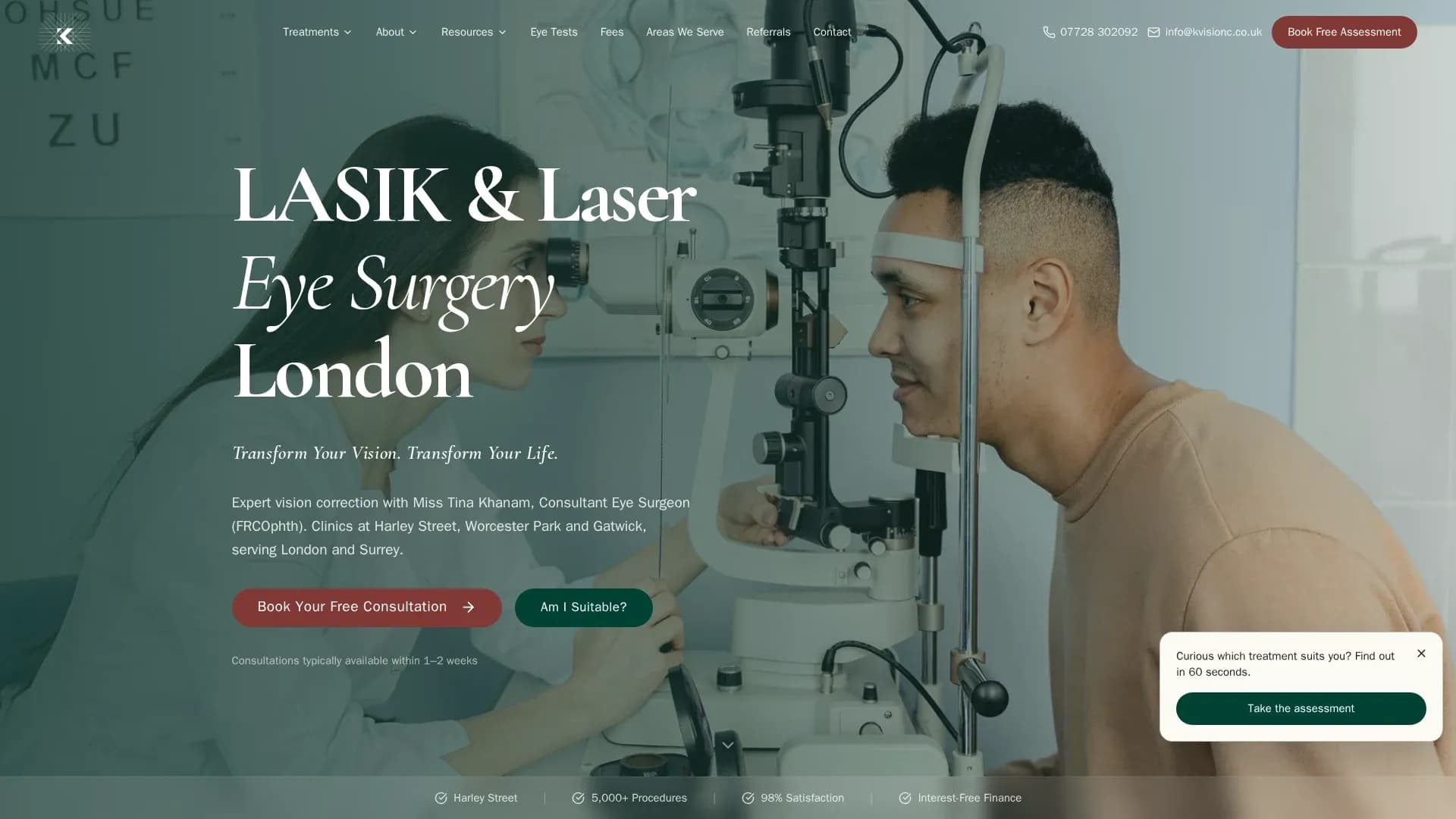
Private ophthalmology is our main specialty. We work with Mr Jesse Panthagani (consultant cataract surgeon, East Midlands), K Vision Centre (Miss Tina Khanam, vision correction surgery across six clinics in London and Surrey) and Menassa Vision (a new practice in Liverpool, Southport and the North West). You get a free audit with a fix list you keep, whether or not you work with us.

Written by Lawrence O'Shea, founder of Aethus · Last checked

What you get

  • Procedure-page SEO for LASIK, cataract surgery, lens replacement and keratoconus
  • Local SEO for "lasik surgeon [city]" and private eye clinic searches
  • Content built around GMC specialist-register and RCOphth credibility
  • Technical fixes prioritised around the consultation-booking journey — page speed, mobile usability, broken enquiry forms
  • Google Business Profile categorised as ophthalmology, not filed under a generic "doctor" listing
  • Visibility tracking against the surgeons and practices your consultations are being compared to
  • A weekly breakdown of what changed on the site, so a broken consultation-booking link is caught in days
  • A monthly report and plan direct from Lawrence, our founder — not a generic agency dashboard

Who does SEO for ophthalmologists in the UK?

Aethus does. We are a UK agency that builds websites and runs SEO for private ophthalmologists, eye surgeons and eye clinics. Several general medical-marketing agencies also take on eye-care clients, so whoever you speak to, ask to see live eye-surgery sites they rank and Google Search Console figures from those practices, not just rankings for a single keyword.

Our three eye-care clients, measured in Google Search Console: Mr Jesse Panthagani's Google search clicks grew 3x (Nov 2025 to Mar 2026), K Vision Centre's grew 18x (Feb to Sep 2026), and Menassa Vision, a new practice with no search history, grew 17x (Mar to Sep 2026). Each case study shows the trend and what we did.

How to get a private ophthalmology practice ranking on Google

These are the steps we follow for every eye practice, in the order that usually makes the biggest difference. You can do much of it yourself; the audit tells you which steps your site already covers.

1. One page for each procedure and condition

A single "eye surgery" page cannot rank for cataract surgery, lens replacement, laser vision correction and keratoconus at once. Give each its own page that answers the questions patients ask: who it suits, how it works, recovery, risks and what it costs.

2. Show who the surgeon is

Name the consultant on every treatment page, with GMC specialist-register status, NHS post, subspecialty training and Royal College of Ophthalmologists membership. Verifiable, named expertise is what Google’s guidelines for medical content look for, and what a cautious patient checks first.

3. A page for every place you consult

Patients search by town. Each clinic or hospital you consult from needs its own page with the address, parking and how to book, and your Google Business Profile should be categorised as an ophthalmologist or eye care centre rather than a general doctor.

4. Publish your fees

"Cataract surgery private cost" is one of the most searched questions in the specialty. A clear fees page, written within the CAP Code rules on pricing, ranks for those searches and saves your secretaries the same phone call.

5. Articles that answer patients’ questions

Patients ask about lens choices, recovery time, driving after surgery and whether they are suitable. Articles written around those questions bring in patients months before they book, and they are what AI assistants quote.

6. Fix the technical basics

Fast pages on mobile, a booking or enquiry form that works, structured data (physician, medical procedure and FAQ schema) and no broken links. These are rarely the reason a practice ranks, but they are often the reason it does not.

7. Reviews, and measuring consultations rather than rankings

Ask every patient for a Google review after their follow-up. Then judge the work on what matters: Google search clicks, enquiries and consultations booked, reported monthly.

SEO for cataract surgeons, laser eye clinics and multi-surgeon practices

The steps are the same, but the emphasis changes with the practice.

Cataract and lens replacement surgeons

Patients are often older, research carefully and are frequently helped by family. Fees, lens options (monofocal, multifocal, extended depth of focus), recovery and self-assessment tools do most of the work. Mr Panthagani’s site uses six self-assessment tools and a cost calculator.

Laser eye surgery and vision-correction clinics

Patients are younger and comparing clinics on price and suitability. Suitability checks, procedure comparison pages (LASIK, LASEK, SMILE, lens implants) and local pages for each clinic carry the weight, and outcome claims need to stay within the Royal College and CAP guidance. K Vision Centre has eighteen local pages around its six clinics.

Practices with several surgeons or clinics

Each surgeon needs a profile that can rank for their own name, and each location needs its own page, without the pages competing with one another. Site structure matters more here than anywhere else.

New practices with no search history

You do not need years of history to be found. Menassa Vision launched in February 2026 with no website, and its Google search clicks grew 17x (Mar to Sep 2026).

Being recommended by ChatGPT and other AI assistants

More patients now ask ChatGPT, Google’s AI answers or Copilot which surgeon to see or what a procedure costs. These tools quote pages that answer the question directly, name the surgeon and their credentials, and are consistent across the web. We write each page that way, add FAQ and physician structured data, and make sure the practice’s details match across its site, Google Business Profile and directory listings.

Mr Panthagani says more of his enquiries now come from Google searches and from ChatGPT conversations.

What GMC and RCOphth standing means for your SEO content

Consultant ophthalmologists sit on the GMC specialist register, and the Royal College of Ophthalmologists publishes guidance on how refractive surgery in particular should be advertised to patients. We surface specialist-register status, subspecialty training and fellowships clearly, and keep outcome and price claims within the CAP Code. Nothing here is legal advice; any claim we are unsure of, we check with you before it goes live.

What we look for in an ophthalmology site audit

We check for a single generic "eye surgery" page standing in for dedicated cataract, lens replacement and laser pages, missing condition pages such as keratoconus despite real search demand, before-and-after or outcome content without proper consent and clinical context, a consultation-booking link that is broken or buried, and a Google Business Profile filed under a general "doctor" category instead of ophthalmology.

How patient video stories work for an ophthalmology practice

Growth adds two captioned patient video stories a month, well suited to a cataract or vision-correction story, where a real outcome described in the patient's own words does more than a statistic. Consent covers the interview and any outcome imagery separately, and the patient approves the final cut before publication.

How we work together

Three ways to work together

Named for what each does, not a generic tier — built around how a ophthalmology practice works. Growth is the level we recommend once you have patients willing to share their story; Ads adds to either level.

Level 1

Essentials SEO

Two locally-focused articles a month, each pointing straight at a booking, backed by weekly reporting so nothing sits broken for long.

  • Two detailed, optimised articles every month, each targeting a search a local patient actually makes
  • Every article links to the service or clinic page that takes the booking
  • A weekly performance breakdown of the site
  • A monthly report from Lawrence, our founder — last month's results and next month's plan
  • Data drawn from leading SEO tools, Google Analytics, Search Console and Aethus Umami (privacy-first analytics)

Why it matters

Weekly numbers mean a problem — a broken booking link, a page that stopped ranking — is caught in days, not found three months later in a quarterly review.

Best for A single practice or clinic ready to be found for the treatments it already offers.

Level 2

Recommended

Growth Platform

Everything in Essentials, plus two captioned patient video testimonials a month and a monthly strategy session with Lawrence.

  • Everything in Essentials SEO
  • Two patient video testimonials a month, recorded from a 20-minute Google Meet call
  • Full recording, editing and upload to your website
  • Burned-in captions, ready to repost to Facebook, Instagram and TikTok
  • A monthly strategy session with Lawrence

Why it matters

Self-paying patients choose on trust. A real patient describing their recovery on the relevant service page does more than any claim we could write — six stories by day 90.

Best for A practice with willing patients and more than one service or clinic to build trust around.

Bolt-on

Add to either level

Google Ads

Complete campaign setup, daily monitoring and weekly tuning — adds to either level, so you get visibility from month one while SEO compounds.

  • Complete setup of targeting, keywords and ad copy
  • Daily monitoring
  • Weekly adjustments to keywords, targeting and copy
  • Conversion tracking set up with your developer, or installed by us (installation may carry a one-off fee)

Why it matters

SEO compounds over months; ads put the practice in front of people searching near each clinic from month one. Ad spend is paid directly to Google, separate from the management fee.

Best for A practice opening a new clinic, or one that wants visibility while the SEO content builds.

Fee
A fixed monthly fee, agreed in writing after the free audit — before any work starts.
Minimum term
Six months on Essentials and Growth, because SEO compounds — then 30 days' notice.
Your contact
A dedicated Partner Success contact you can call any time.
Staying aligned
Regular contact to keep the work aligned with the practice.

The plan

How the first 90 days work

  1. Step 1

    Audit and advise

    We set a baseline, hand over a prioritised fix list, and publish your first content.

  2. Step 2

    Localise the content

    We write for the searches local patients make, and point every article to a booking.

  3. Step 3

    Review and plan ahead

    We report against the baseline and set next quarter's plan.

Month 1

Audit and advise

Essentials

  • Reporting set up with a baseline
  • Prioritised fix list for your developer, starting with anything breaking bookings
  • Posts 1–2 on high-intent local searches

Growth adds

  • Strategy session 1 — agree priority clinics & services
  • Videos 1–2 recorded and captioned

Google Ads adds

  • Targeting, keywords and copy set up
  • Conversion tracking set up with your developer
  • Campaigns launched, with daily monitoring

Month 2

Localise the content

Essentials

  • Posts 3–4
  • Suggested titles & descriptions for key pages, ready to paste in
  • Advice on a page per clinic or location

Growth adds

  • Strategy session 2, reviewing month-1 data
  • Videos 3–4 cut for social

Google Ads adds

  • Weekly keyword and copy tuning
  • Ads scheduled around clinic hours

Month 3

Review and plan ahead

Essentials

  • Posts 5–6
  • Results reported against the month-1 baseline
  • Content plan for next quarter

Growth adds

  • Strategy session 3
  • Videos 5–6 — six patient stories in total

Google Ads adds

  • Budget shifted to what's working
  • Cost per enquiry reported by clinic

By day 90 and what we measure

By day 90 you'll have

  • Six locally-focused articles, each pointing to a booking
  • A prioritised fix list, with titles and descriptions ready to use
  • Weekly breakdowns, three monthly reports and a plan for next quarter
  • Growth: six captioned patient videos and three strategy sessions
  • Ads: live campaigns with 90 days of results

What we measure every month

  • Search impressions for your priority treatment searches
  • Clicks through to the booking page
  • Booking enquiries, by clinic
  • Ads: cost per booking enquiry

Getting started

What we'll need from you

  • Access to your website, so we can publish posts and videos
  • Your developer's contact, for the fix list and tracking
  • Access to Google Analytics and Search Console
  • Clinic details — addresses, areas served, and the services at each
  • Willing patients, two a month (Growth)
  • Access to your Google Ads account and a monthly budget (Ads)

Results

What happens to a practice's Google presence after we rebuild it

Three private eye-care practices, tracked month by month in Google. The lines show direction and shape. The figures stay private.

  • People arriving from Google
  • Appearances in Google results
  • Old website

Vision-correction clinic, London & Surrey

Old site flatlined. The new one climbed.

Before and after the rebuild. The line turns where the new website went live.

Use the left and right arrow keys to step through the months. Monthly counts are not shown.

Read the case study

See all results

Source: Google Search Console, monthly, between Sept 2025 and Sept 2026. Shown as trends, not figures, to protect our clients’ privacy.

Frequently asked questions

Who does SEO for ophthalmologists in the UK?

Aethus is a UK agency that runs SEO for private ophthalmologists, cataract surgeons and eye clinics. Our clients include Mr Jesse Panthagani, K Vision Centre and Menassa Vision, whose Google search clicks grew 3x, 18x and 17x respectively. Whoever you choose, ask for live eye-care sites and Google Search Console figures.

What does ophthalmology SEO include?

A page for each procedure and condition, surgeon credentials on every treatment page, local pages for each clinic, a Google Business Profile categorised as ophthalmology, a fees page, patient-question articles, technical fixes and structured data, review requests and a monthly report on clicks and enquiries.

How do I get my private ophthalmology practice ranking on Google?

Give every procedure its own page, name the surgeon and their GMC and Royal College credentials, add a page for each place you consult, publish your fees, write articles around the questions patients ask, fix speed and mobile issues, and collect Google reviews. Our free audit shows which of these your site is missing.

Is SEO for cataract surgeons different from SEO for laser eye clinics?

The steps are the same but the emphasis differs. Cataract patients tend to be older and research fees, lens choices and recovery. Laser and vision-correction patients compare clinics on price and suitability, so suitability checks, procedure comparisons and local pages matter most.

Can you help my practice appear in ChatGPT and AI search answers?

Yes. AI assistants quote pages that answer questions directly and name the surgeon and their credentials, so we write every page that way, add structured data and keep your details consistent across the web. Mr Panthagani reports more enquiries from ChatGPT conversations since we rebuilt his site.

Do you also run Google Ads for eye clinics?

Yes, as an add-on to SEO. Ads put the practice in front of patients searching near each clinic from month one while the SEO builds. Ad spend is paid directly to Google, separately from our management fee.

How much does ophthalmology SEO cost?

A fixed monthly fee, scoped to your practice after the free audit. We don't publish a figure here because it depends on the procedures and catchment we're targeting. Essentials and Growth run to a six-month minimum, because SEO compounds, then 30 days' notice.

How long until we see more consultation bookings?

Most private ophthalmology practices see meaningful movement in three to six months. Menassa Vision, a new practice, grew its Google search clicks 17x (Mar to Sep 2026). A niche page such as keratoconus often ranks faster than a broad term such as laser eye surgery.

Do we need a new website before starting SEO?

Not usually. We run SEO on your existing site. If the audit finds the site itself is holding you back, for example a single page covering every procedure, we tell you and explain the options.

Can you feature our GMC specialist-register status and RCOphth credentials?

Yes. We build surgeon-profile content around verifiable GMC specialist-register entries, subspecialty training and Royal College credentials, which supports both patient trust and Google’s expectations for medical content.

How do you handle refractive surgery advertising guidance?

We write laser and refractive-surgery content in line with Royal College of Ophthalmologists and CAP Code guidance on how outcomes, risks and prices can be presented, so claims stay evidenced and balanced. This is not legal advice; anything borderline, we check with you before it goes live.


Book a call with Lawrence

  • Where patients are dropping out of your search results
  • What we'd fix first in the 90-day plan
  • Whether we’re the right fit
“Since Aethus rebuilt my site around patient questions, more of my enquiries come from Google searches and from ChatGPT conversations, and I’m seeing more self-referring patients. The articles do the explaining before the consultation, so the patients who reach me are ready to talk about treatment.”— Mr Jesse Panthagani, Consultant Ophthalmic Surgeon, private practice
5.0 · 7 Google reviews

Pick a time — it takes under a minute.

Loading available times…

Source: Free audit, no obligation. Fixed monthly fee agreed in writing before any work starts.

Not ready to talk?

Compliance Scorecard. 12 questions on CQC display, UK GDPR/PECR, accessibility and advertising rules. Instant score and a plain-English action plan. Take the compliance scorecard →

Ophthalmology SEO for UK Eye Surgeons and Private Eye Clinics

5.0 · 7 Google reviews

Free audit, no obligation. Fixed monthly fee agreed in writing before any work starts.

Award-winning web designHealthcare websites since 2015Senior-led deliveryBedford, UK
Privacy by designICO registeredWCAG 2.2 AA
5.0 · 7 Google reviewsBest Website UK at the UK Property Awards 2026–2027 — won by Cranberryhome's website, designed and built by Aethus

Trusted by growing UK businesses and clinics

  • Universally Bedford
  • Bricking It
  • CranberryHome
  • K Vision Centre
  • Menassa Vision
  • Panthagani